The research note: three claims to examine
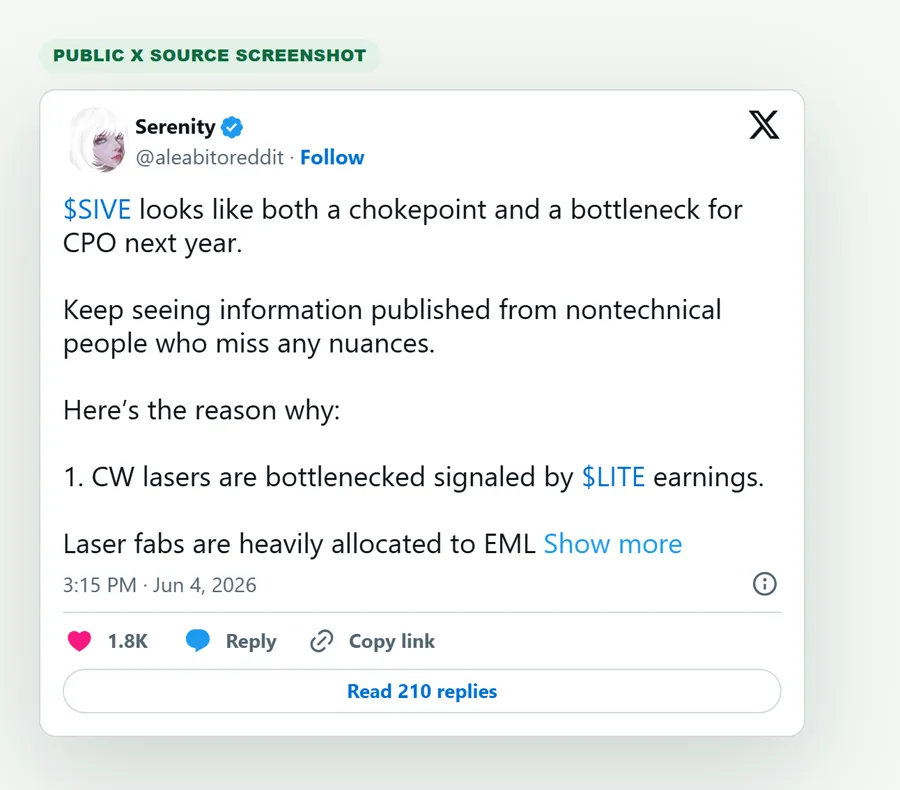
In the June 4 post, Serenity argues that Sivers could become a hard-to-replace laser supplier as CPO demand grows toward 2027. SIVE is the ticker for Sivers Semiconductors, whose shares trade on Nasdaq Stockholm.
Split the thesis into claims you can examine separately. The table below is an example research note assembled from the post and the company announcement.
| Point | What the sources say | Next research question |
|---|---|---|
| GlobalFoundries relationship | Sivers' June 2 announcement says its laser arrays will be integrated into GF silicon-photonics reference designs and made available in the SCALE platform. | Which qualification and production milestones have the companies announced? |
| Supplier position | Serenity's post argues that customers may have few alternatives to Sivers. This is the author's interpretation of the supply chain. | Which other laser suppliers qualify for the same applications, and what would switching require? |
| Commercial timing | The post connects its demand scenario to 2027. The company announcement describes the collaboration and intended applications. | What orders, delivery schedules, capacity plans, or revenue guidance link the collaboration to that timetable? |
Collect the post and the company document
Use CarryFeed's X search to search from:aleabitoreddit SIVE. Open the original post and collect its text, URL, author, and publication date. If you already have the link, open it in the Twitter viewer.
The June 4 post names SIVE, LITE, NVDA, SNDK, MRVL, COHR, AVGO, MTSI, JBL, GFS, and AMD. Keep that list as the author's named set, then choose the company you want to investigate. This example follows Sivers.
Add the Sivers–GlobalFoundries announcement as the second input. It describes laser-array integration and names CPO and linear pluggable optics (LPO) among the intended architectures. Save its June 2 publication date with the link.
Export the readable viewer result as Markdown to keep its text and source URL together. Add the relevant company passages and their publication dates to the same note.
The saved preview below stops at Show more. Read the continuation before asking for a summary. For posts with charts or attachments, include those files or identify which ones you still need.
If you work inside an AI client, CarryFeed's MCP connection also includes a public-post retrieval tool. Keep the company document beside the returned post text when using the prompt below.
Ask AI to connect each claim to a source
Paste the post text and the relevant company passages below this prompt. Include each source's URL and date. Ask for a compact note that you can extend as you read more documents.
Build a stock research note from the post and company documents below. Use the supplied material.

Identify the main company and its ticker and exchange where supplied. Summarize the author's thesis in plain language, keeping qualifiers such as likely or could.

Create a table with these columns:
- Claim
- Supporting source URL, date, and relevant passage summary
- Author assumption or unresolved question
- Company document or disclosure to read next

For the Sivers example, examine the GlobalFoundries relationship, alternative laser suppliers, and the qualification-to-production timetable. Attribute the thesis to its author and the company statements to their documents.

If a required document or attachment is missing, name it in the next-document column. Keep a dated forecast separate from a later reported result.

Sources:
[Paste post text, company passages, URLs, and publication dates here.]
Keep the author's assumptions in the summary
Suppose an AI draft says: “Sivers is the only supplier and will capture the CPO market in 2027.” That illustrative sentence combines supplier status and a future outcome into a firm conclusion.
A more useful note would read: “Serenity's June 4 post argues that Sivers could be difficult to replace in parts of the CPO laser supply chain. Sivers' June 2 announcement describes planned laser-array integration with GlobalFoundries. Alternative suppliers and the timing of commercial orders remain research questions.”
Read the sentences against their linked sources. Watch for a forecast becoming a reported result, a partnership becoming an exclusive contract, or an author's estimate becoming company guidance. A skeptical reply is useful when it addresses the same company and claim; follow its quoted post before adding it to the note.
Choose the next company document
For the June 4 starting point, Sivers' Q1 2026 report was already available, published on May 28. For a later follow-up, use the quarterly reports and recorded presentations to add newer disclosures with their publication dates.
Start with the question that matters most to the thesis. For this case, the link between technical integration and commercial deliveries is a useful place to begin.
- Revenue: identify the Photonics business figures and any disclosed contribution from the relevant products.
- Customers and orders: distinguish named collaborations, development work, and disclosed commercial orders.
- Production: look for qualification stages, capacity commitments, and dated delivery milestones.
- Funding: read cash flow and financing disclosures alongside plans for expansion.
Carry the open question into the next reading
When a new document answers an open question, add its publication date and the relevant passage to that row in the saved note. Keep the earlier forecast for comparison.
To repeat the process with another stock idea, search the public handle and ticker, collect the company material that addresses its main claim, and use the prompt above to build your first note.